
A standard .com costs somewhere between $10 and $15 a year to renew. That is the honest answer, and everything else on this page explains why you will be quoted anything from 99 cents to several thousand pounds for what looks like the same thing.
The short version: a registry sets a wholesale price that no registrar can go below, your registrar adds a margin on top, and the cheap first year you are being advertised is a loan you repay at renewal. If you are new to the terminology, our guide to what a domain name is covers registries, registrars and how the whole system fits together.
Domain name cost at a glance
| What | Typical yearly cost |
|---|---|
.com renewal | $10 to $15 |
.co.uk renewal | £8 to £12 |
Newer endings such as .shop, .online | $2 first year, $25 to $40 to renew |
Premium endings such as .io, .ai | $35 to $120 |
| WHOIS privacy | $0 to $15, and it should be $0 |
| Transfer to another registrar | Usually the price of one year |
| Restoring an expired domain | $80 to $200 |
| A name someone already owns | $500 to six figures |
Figures checked on 10 August 2026. Domain pricing moves, so treat these as the shape of the market rather than a quote.
Why no domain is truly cheap
Every .com in the world is sold wholesale by one company. Verisign runs the registry, and every registrar on earth pays the same price for stock. That price is currently $10.26 per year, and it rises 7 percent to $10.97 on 1 November 2026. On top sits a small ICANN fee of about 20 cents per domain per year.
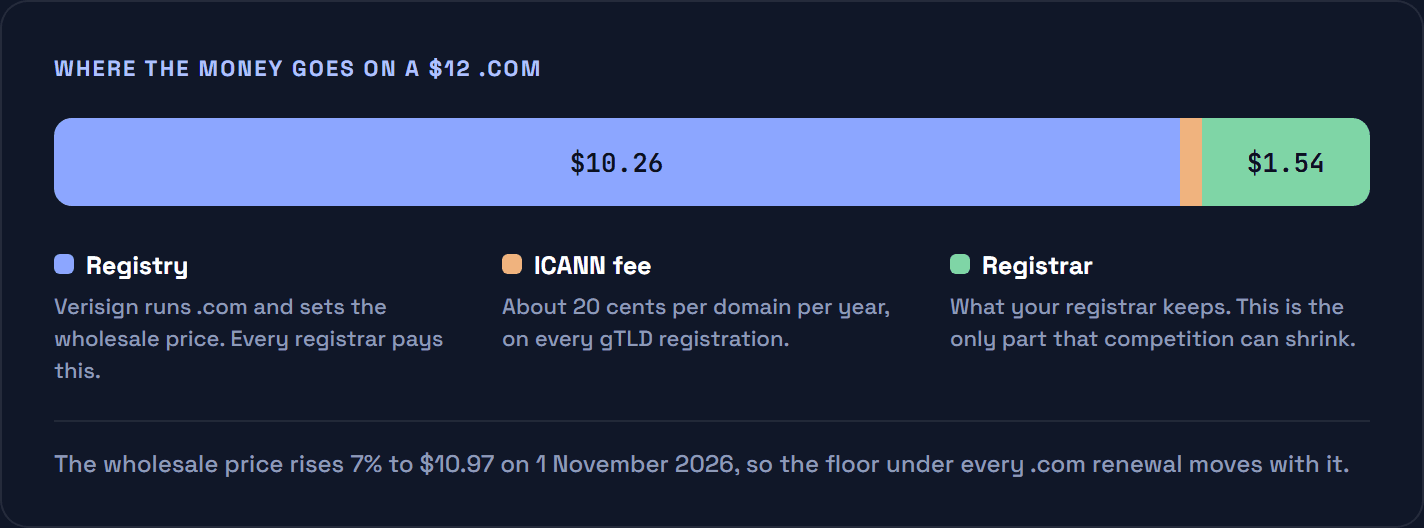
That is the whole economics of the industry in one bar. The registrar controls only the last slice, which is why the difference between a cheap registrar and an expensive one at renewal is a couple of pounds rather than a fortune, and why anything advertised at $1 for a .com is being sold below cost to acquire you.
It also means the floor moves. When the wholesale price goes up in November, every registrar’s renewal follows it. Nobody absorbs 71 cents a domain across millions of registrations out of goodwill.
The first year is not the price
This is the single most expensive misunderstanding in the whole subject. Registrars advertise the first year and earn on the renewal. A few real patterns:
- An ending offered at $1.99 for year one that renews at $32. Over five years that is $129, not $10.
- A
.comat $7.90 in year one that renews at $21.35, which is double what a plain-dealing registrar charges. - Bundles where the domain is free with hosting, and the domain quietly renews at a premium once the hosting term ends.
The fix takes ten seconds: find the renewal price before you buy, multiply it by five, and compare that number instead. A registrar that charges $11 flat beats one that charges $2 then $30 before you reach year two.
What actually changes the price
The ending you choose
There are 1,438 top level domains and each registry sets its own wholesale price. .com is mid-range. Country codes are usually cheap in their home market. Endings aimed at a lucrative niche are priced accordingly, which is why .ai costs several times a .com and is normally sold in two-year blocks.
Here is roughly what the common endings cost. First-year figures are what you will see advertised; the renewal column is what you actually live with.
| Ending | Typical first year | Typical renewal | Best suited to |
|---|---|---|---|
.com | $8 to $12 | $11 to $15 | Almost anything, and still the default |
.co.uk | £5 to £10 | £8 to £12 | UK businesses selling to the UK |
.net | $10 to $14 | $14 to $18 | Technical projects and networks |
.org | $8 to $12 | $13 to $18 | Charities, communities, open source |
.io | $28 to $45 | $45 to $70 | Startups and developer tools |
.ai | $70 to $120 | $70 to $120 | AI products, usually sold two years at a time |
.dev, .app | $9 to $15 | $14 to $20 | Developer sites, with HTTPS enforced |
.shop, .online, .site | $1 to $5 | $25 to $40 | Cheap to start, expensive to keep |
.co | $10 to $15 | $25 to $35 | A near miss for .com, at a price |
The bottom three rows are where the biggest gap between advertised and actual sits. An ending at $1.99 that renews at $32 will have cost you more than a .com by the middle of year two, and will keep costing more every year after that.
Premium and aftermarket names
Two different things wear the same word. A registry premium is a name the registry itself has priced above standard, often with a premium renewal every year thereafter, which is the part people miss. An aftermarket name is one somebody already owns and will sell you, priced at whatever they think you will pay. Short, dictionary-word .com names sit in the thousands and up.
The ten year number
Domains are not a one-off purchase, so the figure worth comparing is what the name costs over the life of the business. A .com at $12 a year is about $120 a decade, and even with the increases now scheduled it stays close to $140. A .shop bought for $1.99 and renewed at $32 is over $290 across the same period. Neither number is large, but one of them is nearly three times the other for an address that does exactly the same job.
Currency and VAT
Most registrars price in dollars. A UK buyer pays the exchange rate and, on many registrars, VAT on top. A $12 domain is not £12, and the invoice can land 20 percent above the sticker.
The domain is the cheap part. The hosting decides how it performs.
LiteSpeed with server-level caching, free Redis, staging on every site, and engineers who migrate you across by hand at no cost. From $25 a month, renewing at $25.
The top 10 domain registrars, cheapest first
Ranked by what a .com costs to renew, because that is the number you pay every year after the first. All are ICANN accredited, which you can confirm against the official accredited registrar list. Bands rather than exact figures, because registrar pricing changes weekly and a precise number here would be wrong within a month.
| # | Registrar | .com renewal | Privacy | Known for | Watch out for |
|---|---|---|---|---|---|
| 1 | Cloudflare Registrar | At cost | Free | Sells at the wholesale price with no markup at all | No phone support, and it only handles the endings it supports |
| 2 | Porkbun | $11 to $12 | Free | Free privacy and free SSL, published prices, no upselling | Smaller company, support is email and ticket only |
| 3 | Spaceship | $10 to $12 | Free | Clean modern panel, aggressive pricing, run by Namecheap | Newer, so a shorter track record than the rest |
| 4 | NameSilo | $11 to $13 | Free | Flat pricing with almost no promotional games, bulk tools | The interface looks like it was built in 2011 |
| 5 | Dynadot | $11 to $14 | Free | Developer friendly, solid API, free privacy and email forwarding | Occasional promo-driven pricing on newer endings |
| 6 | Namecheap | $15 to $19 | Free | Huge selection, privacy included for life, good documentation | Renewals have drifted well above the cheapest tier |
| 7 | Gandi | $16 to $22 | Included | Long-standing, strong on European endings, no dark patterns | Among the more expensive, and prices rose sharply in recent years |
| 8 | Hover | $17 to $20 | Free | The cleanest buying experience of any registrar, zero upsells | You pay for that simplicity |
| 9 | GoDaddy | $20 to $25 | Paid extra | The largest registrar, everything under one roof, phone support | Relentless upsells and privacy is a paid add-on |
| 10 | IONOS | Varies widely | Varies | Very cheap first year, bundled with hosting and email | The renewal is where the money is made; read the small print |
Two of these are worth a closer look. Cloudflare Registrar genuinely does not mark domains up, so it is the cheapest option that exists by definition, at the cost of it being a bare-bones service aimed at people who already know what they are doing. Porkbun lists .com at $11.08 with free WHOIS privacy and free SSL included, and publishes renewal prices openly rather than burying them, which is rarer than it should be.
We have deliberately not printed review scores. Ratings on the big review sites shift constantly and are heavily gamed in this industry, and a number here would be stale before you read it. The last two columns tell you more about what living with each one is actually like.
The extras that quietly add up
| Extra | Typical cost | Do you need it? |
|---|---|---|
| WHOIS privacy | $0 to $15/yr | Yes, and refuse to pay for it. Most good registrars include it. |
| SSL certificate | $0 to $80/yr | No. Free certificates are standard and included on every FastCow plan. |
| Email hosting | $1 to $6 per mailbox | Only if you want a branded address. It is not part of the domain. |
| DNS hosting | Usually free | Included with your registrar or your host. Never pay separately. |
| Redemption after expiry | $80 to $200 | Avoidable entirely with auto-renew. |
| Transfer out | Cost of one year | It adds a year to the registration, so it is not really a fee. |
The SSL line is the one worth pushing back on hardest. Free automated certificates have been standard for years, and any registrar still charging $60 a year for basic domain-validated SSL is selling you something the rest of the industry gives away. Ours come free and renew themselves, as part of how we handle site security.
What a domain is attached to
The domain itself is the cheapest part of being online, and on its own it does nothing. It is an address with no building behind it until you point it at something:
- Hosting. The server that stores your files and serves your pages. This is the real recurring cost, and the one that decides whether your site is fast. Our guide to the different types of hosting covers the options, and managed WordPress hosting is where most small businesses land.
- DNS. The records that connect the address to the server. Free, and managed from your control panel.
- Email. Separate from your website, and priced per mailbox.
- SSL. Should be free and automatic.
- The website itself. Either your time, a builder subscription, or a designer. Usually the largest number of the lot.
A common shape for a small business: $12 a year for the domain, $25 a month for hosting that can actually take traffic, and a one-off build cost. The domain is a rounding error, which is exactly why it is not worth choosing a registrar on a two pound saving and it is worth choosing a host carefully. If you already have a site elsewhere, moving it across is free.
Seven ways to pay less
- Compare renewals, never first-year offers. The renewal is the price.
- Register for several years at once. It locks in today’s rate before the November increase and removes the risk of a lapsed card.
- Refuse to pay for privacy. Free at almost every registrar on the list above.
- Transfer away from an expensive registrar. A transfer adds a year, so you rarely lose anything. Our walkthrough of transferring away from GoDaddy applies to any registrar.
- Skip the defensive registrations. Your main ending and one obvious variant. Not forty.
- Check whether the ending is premium before you fall in love. A premium renews at the premium rate every year, not just the first.
- Turn on auto-renew. A single missed renewal costs more than a decade of choosing the cheaper registrar.
FAQs
A standard .com is typically $10 to $15 a year to renew, and a .co.uk is usually eight to twelve pounds. Newer endings often advertise a first year under $5 and renew at $25 to $40. Premium endings such as .io and .ai run from $35 to well over $100.
Because the first year is a promotion. Registrars discount registration to win customers and make their margin on renewals, when moving is more effort than staying. Always check the renewal price before you buy, and compare that number rather than the headline.
Cloudflare Registrar is the cheapest by definition because it sells at the wholesale price with no markup, though it is a deliberately minimal service. Porkbun, Spaceship, NameSilo and Dynadot are all close behind and include WHOIS privacy free.
Sometimes, bundled with a hosting plan or a website builder for the first year. It is a real saving of about ten pounds, but check what it renews at and confirm the domain is registered to you rather than to the provider, so you can move it later.
Either the registry has classed the name as premium and priced it above standard, or somebody already owns it and is willing to sell. Short, memorable, dictionary-word .com names are the ones that reach the higher figures.
Yes. Verisign, which runs .com, is raising its wholesale price 7 percent to $10.97 on 1 November 2026, and its contract permits further increases in the years that follow. Registrars pass those through, so expect gradual rises across the market.
The per-year price is usually the same, so the saving is not really financial. What you get is protection: you lock in the current rate before increases and you cannot lose the domain to an expired payment card. On anything that matters, it is worth doing.
No, and there is a reasonable argument for not doing so. Keeping them separate means a dispute with one company cannot hold the other hostage. All that is needed is to point the domain’s nameservers at your host.
The short version
Budget $10 to $15 a year for a .com and treat anything cheaper as a first year promotion you will repay later. The registry takes most of it, so the gap between registrars at renewal is small, and the ones that keep it small also tend to include privacy and SSL rather than charging for them.
Pick from the top of the table, register for a few years, turn on auto-renew, and stop thinking about it. Then spend the attention you saved on the hosting, because that is the part of the bill that decides whether anyone enjoys using the site.